
Locked Out With No Notice
A McMaster PhD student rented a room in a Hamilton home. He paid every month in full, including his last month in advance. On October 19, 2026, while he was away from the house, the locks were changed, his belongings were packed by the landlord and left on the front porch, and he was told he had “no lawful authority to enter.” Then he found out that the law everyone assumes protects tenants may not cover him at all.
Account of a McMaster University PhD student (name withheld at the author’s request) · Published October 20, 2026 · Compiled from the author’s own records: his messages, his email, his bank and transfer confirmations, and the landlord’s own written agreement. Nothing on this page comes from outside those records.
The arrangement
The author is a doctoral student at McMaster University. In September 2026 he rented a room in a house at 57 Tisdale Street South, Hamilton, owned and occupied by Jessica McKee. Rent was $850 per month, all inclusive, due on the first. He shared the kitchen, bathroom, and toilet with the homeowner, who lives in the house full-time.
The terms were set out in the landlord’s own document, titled “Room Rental Agreement” and dated August 5, 2026:
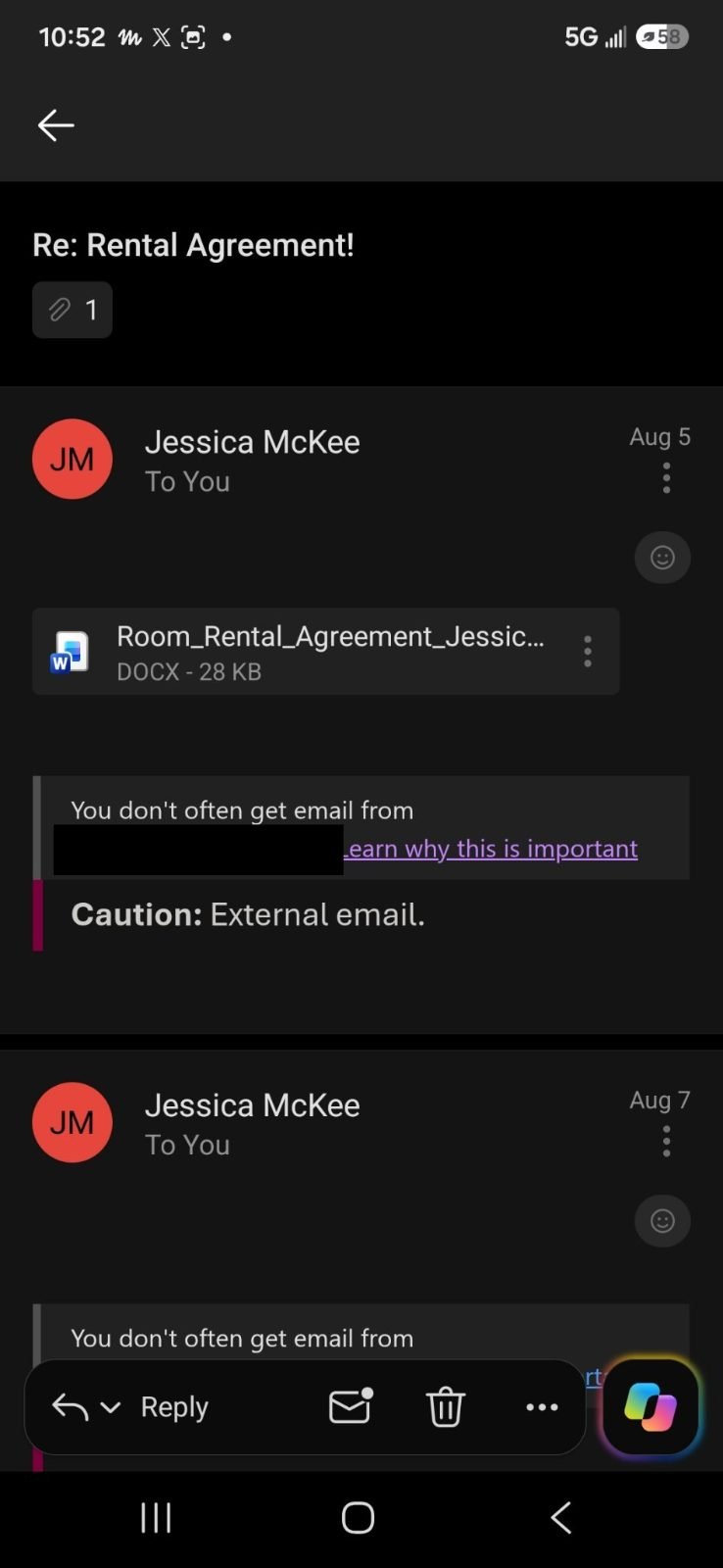
The agreement contains no guest rule of any kind — no ban on overnight guests, no restriction on visitors, nothing. The copy the author holds has blank tenant signature lines.
One more standing condition of the room: the bedroom door has no lock. The author could not secure his room or his belongings at any time — not while sleeping, not while out of the house.
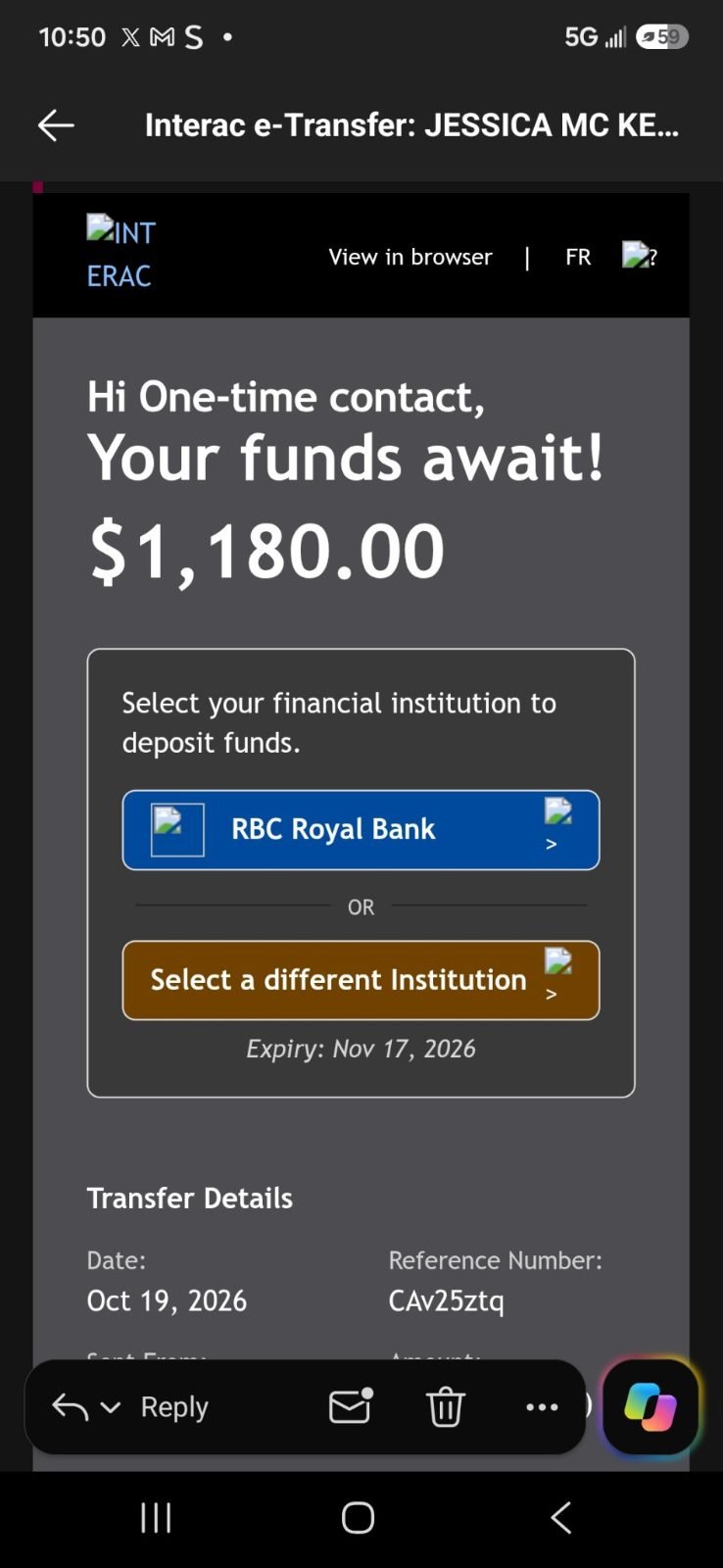
The money — every dollar documented
After the lockout, the landlord sent a refund of $1,180 by e-transfer: $850 (last month’s rent) plus $330 (pro-rated October rent).
What happened — the full timeline
- Oct 12–13, 2026
Shared-supplies disagreement
A verbal disagreement on the night of October 12 over shared supplies the landlord said the author had used, and their cost. His written account, sent at 12:01 AM on October 13, says he was not given the opportunity to speak. The $20 payment above was sent that night.
- Fri Oct 16, 11:11 PM
Written notice of a visit
The author messaged the landlord that a colleague of his would visit the next day, and that the colleague was not staying over.
- Sat Oct 17, 10:12 AM
Written approval — and the first mention of any guest rule
The landlord replied in writing that the visit was fine: “Ok cool. I’m ok.” In that same message, she mentioned a no-overnight-guests rule for the first time in writing, saying they had talked about it before. The author replied at 10:13 AM that his colleague was staying only a short period, not even until the afternoon. The visit went ahead in the daytime. There was no overnight stay.
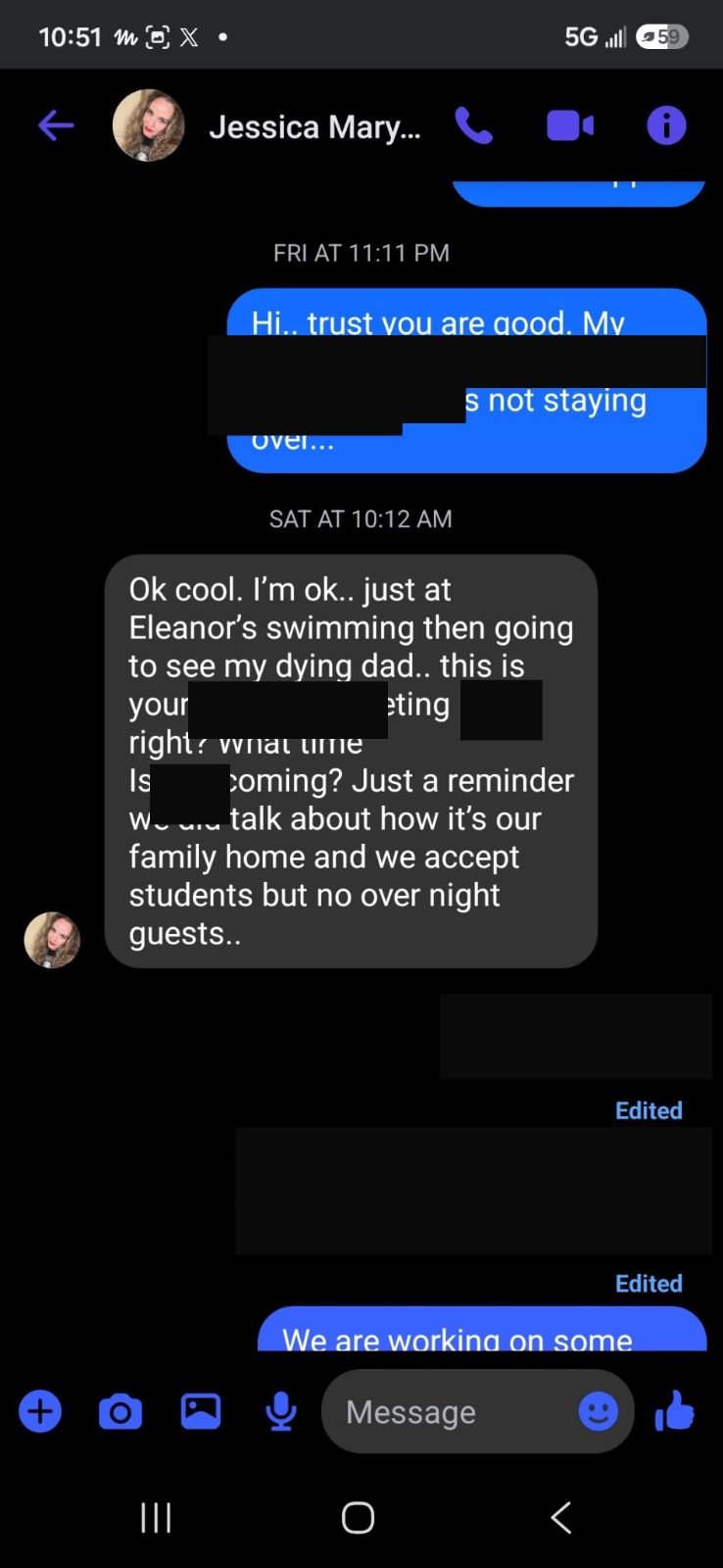
The messages themselves. Friday, October 16, 11:11 PM: the author gives notice of the visit and states his colleague is not staying over. Saturday, October 17, 10:12 AM: the landlord approves the visit — “Ok cool. I’m ok” — and, in the same message, mentions a no-overnight-guests rule for the first time in writing. The author’s replies below it are covered in this copy at his request. The word identifying the guest has been covered in this copy at the author’s request; the unedited original is held in his records. Screenshot from the author’s own Messenger thread. The author has since reviewed the entire written record: 182 messages in the direct thread (September 18 – October 18) plus the house group chat. The word “guest” appears exactly once — in that October 17 message. No guest rule, sleepover rule, or house rule of any kind appears in writing anywhere before October 17, and none appears in the landlord’s own agreement.
- Sat Oct 17, night
Door knock and bathroom confrontation
The landlord knocked on the author’s bedroom door at night. When he opened it, she repeatedly asked “are you okay, are you okay.” She took him to the bathroom and confronted him about a strand of his hair on her toothbrush, which she had left on the shared sink; the hair likely fell while he was shaving. She also criticised him for wearing boots in the house.
- Sun Oct 18, morning
Raised voice, “boundaries”
The landlord confronted the author again, raising her voice, saying she was “drawing the boundaries.” She accused him over his cupboard being open and told him he does not have the right to bring anyone over to her house — the day after she had approved the visit in writing.
- Sun Oct 18, 12:26 PM
The author’s formal letter
The author sent the landlord a formal letter restating the agreement and the written sequence. He confirmed he would respect a no-overnight-guests rule going forward, but not a total ban on visitors, which was never agreed and which she had approved in writing the day before. He asked that all communication be in writing, that changes be agreed in writing, that there be no night visits or room entry without permission except emergencies, and that any end to the arrangement come with written notice running to the end of the semester (end of December), with unused prepaid rent returned. He noted he was keeping a record and taking legal advice.
- Mon Oct 19, ~3:06 PM
The lockout
One day after that letter, the landlord emailed a formal Notice of Termination effective immediately: the locks had been changed, the author had “no lawful authority to enter,” his belongings had been packed and placed on the front porch, her brother was inside the house with her, and police had been “already notified.” The author was at/near campus when the email arrived. No notice period of any kind was given. Her full email is reproduced in Section 4 below.
- Mon Oct 19, afternoon
Police response
The author called Hamilton Police, including a 911 call of about ten minutes. Police told him he “wasn’t covered”: because he shares a kitchen and bathroom with the owner, they treat the arrangement as outside the Residential Tenancies Act — a civil matter — and they would not force re-entry.
- Mon Oct 19, evening
The university steps in
The author’s PhD co-advisor directed him to McMaster’s Employee and Family Assistance Program (EFAP, Telus Health) for legal counselling and temporary housing. McMaster staff connected him to the university residence office the same afternoon. By that evening he had signed emergency housing at McMaster’s 10 Bay Residence (Unit 305A, October 19 – November 19, 2026) — a second rent, on top of the rent already paid at Tisdale.
- Mon Oct 19, 9:17 PM
The cash and the passport
The author reported that US$2,150 in cash had been kept in his room, close to his passport — both were in the room when the landlord packed it, alone, in his absence. She states the packing was video-documented. That evening she messaged that the packed belongings were on the porch, and that if he could not collect them that night she would bring them inside “to prevent theft” and put them back out the next morning. See Section 5.
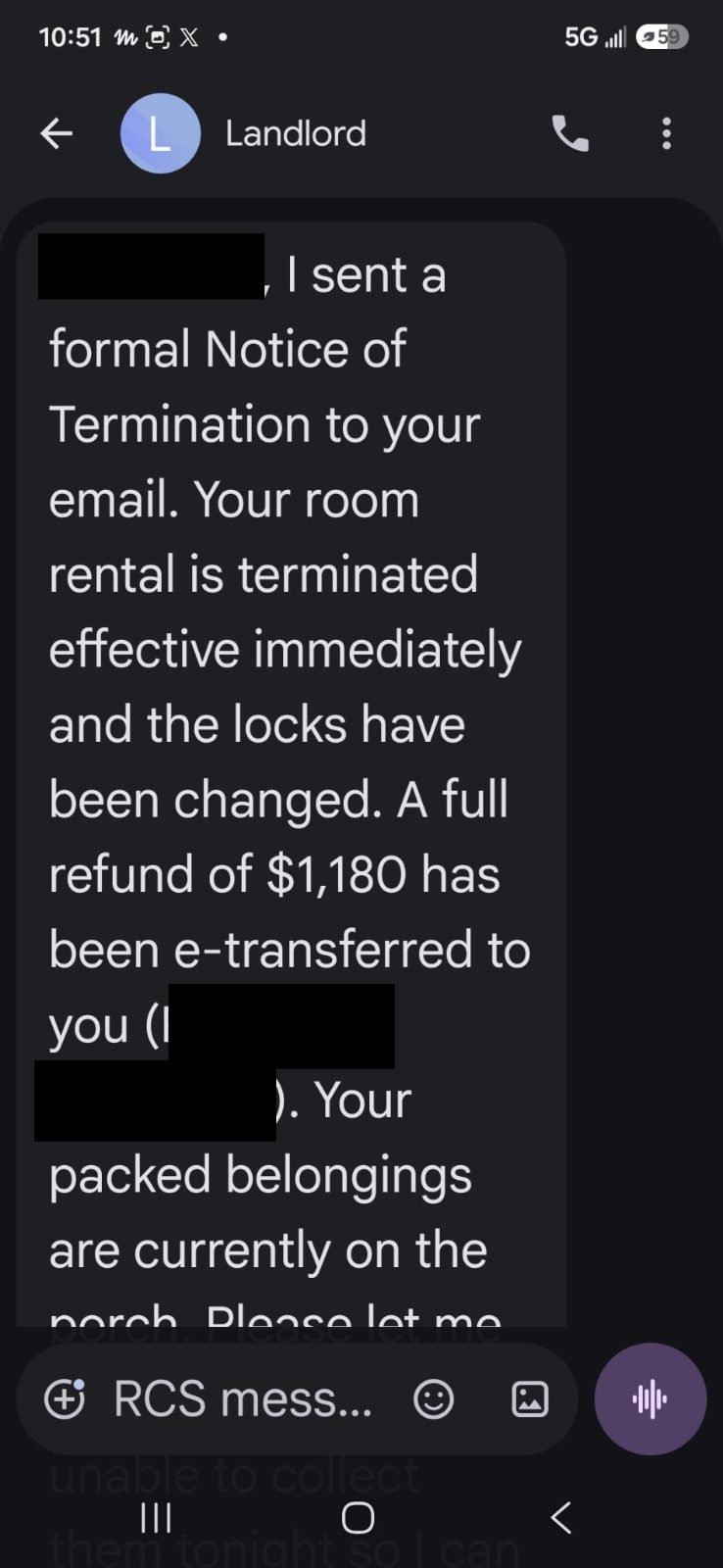
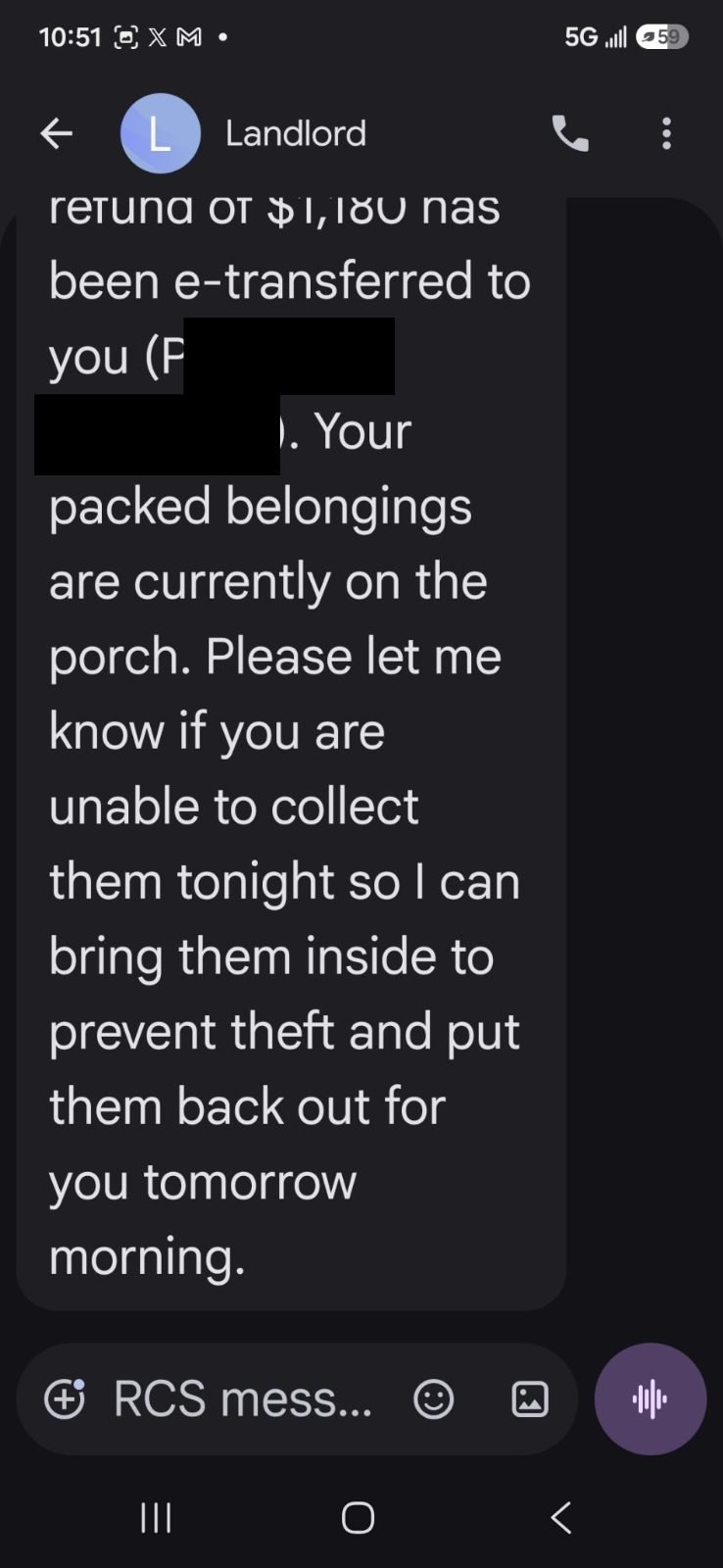
The landlord’s text message that night (an RCS text; the contact is saved as “Landlord” in the author’s phone), shown in two screenshots: the termination effective immediately, the changed locks, the $1,180 refund, the packed belongings on the porch — and the offer to bring them back inside “to prevent theft” and put them out again the next morning. The tenant’s name and the e-transfer password are redacted in these copies; the unedited originals are held in the author’s records.
- Tue Oct 20, morning
The doors keep closing
McMaster’s Student Case Management office replied, offering a Case Manager appointment and recommending the Hamilton Community Legal Clinic. The author also called the Landlord and Tenant Board’s contact centre (1-888-332-3234). The Board decides cases under the Residential Tenancies Act — the same Act the police say does not cover this room. The author recorded his own video collecting his belongings.
Video: the author returning with the police to pick up his belongings.Watch on YouTube ↗
The termination email, in her own words
— Email from Jessica McKee to the author, Monday, October 19, 2026. The tenant’s name and the e-transfer security password line are withheld. Original held in the author’s records.
Note what the email does not mention: the US$2,150 that was in the room she packed.
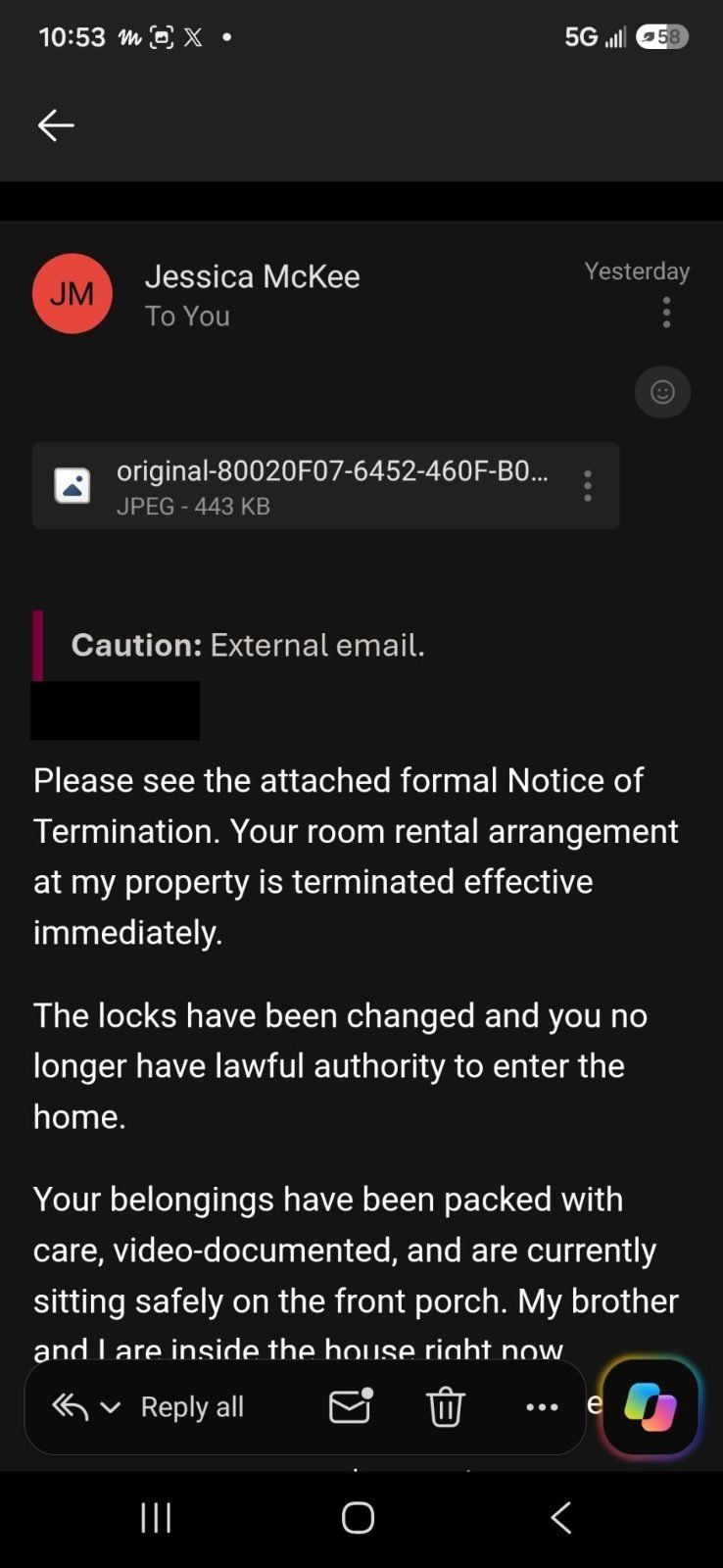
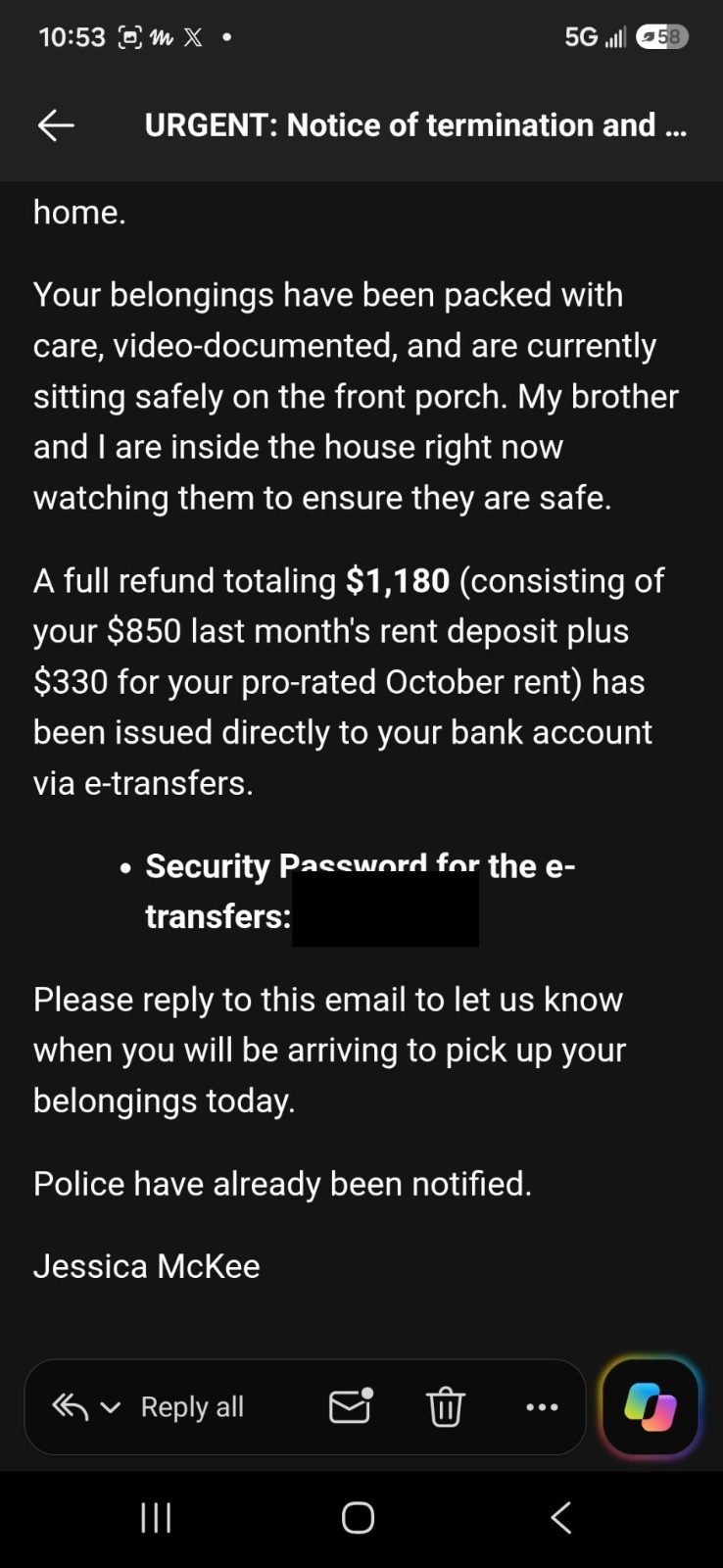
The email itself, in two screenshots (subject: “URGENT: Notice of termination…”). The formal Notice of Termination was attached as a JPEG image (443 KB). The tenant’s name in the greeting and the e-transfer security password are redacted in these copies; the unedited originals are held in the author’s records.
The US$2,150
This section is the author’s own report, stated plainly so it can be answered.
The author kept US$2,150 in cash in his room at 57 Tisdale, close to where his passport was kept. The bedroom door had no lock. On October 19, while the author was away from the house, the landlord entered the room, packed all of his belongings herself, and placed them on the front porch. She says the packing was video-documented. The entire chain of custody — the packing, the filming, the porch — rests on her own messages.
As of publication, the author reports that he is out that US$2,150, and no one in authority has taken the report anywhere: the police treat the tenancy as a civil matter, and the tenancy board’s reach is the very question in dispute. The author filmed his own collection of his belongings. The landlord is invited to produce the packing video she says she recorded, and to account for the cash and the passport that were in the room.
“You’re not covered” — the gap every student should know about
In short: if you share a kitchen or bathroom with the owner of the house, Ontario’s tenancy law may not protect you — even if you pay rent every month. Ask that one question before you sign, and get every rule in writing.
Ontario’s Residential Tenancies Act (RTA) is the law most renters assume protects them: notice periods, no lockouts, a tribunal to hear disputes. But the Act has an exemption. If you rent a room in a home where you share a kitchen or bathroom with the owner, the RTA may not apply to you at all (RTA s. 5(i)). In that case:
That is the position the author was put in on October 19: locked out the same day, and each authority pointing at the limits of its own coverage.
The author’s remaining routes are the ones he is pursuing: the Hamilton Community Legal Clinic for advice, McMaster’s Student Case Management office, and — for the money — a claim in court if the cash and the room’s contents are not accounted for. The RTA exemption, even if it applies, does not erase a contract, does not transfer ownership of a tenant’s belongings, and does not answer for money that was in the room.
For students: protect yourself before you sign
Ask the coverage question first: “Will I share a kitchen or bathroom with the owner?” If yes, understand that the RTA — and the Landlord and Tenant Board — may not cover you.
Get the agreement in writing, and read what is NOT in it. Every rule the landlord later claims — guests, visitors, quiet hours — should be in the document. If it is not written, it was not agreed.
Check the bedroom door. If your room has no lock, anything you keep in it is unsecured. Say so in writing before you move in.
Pay only by traceable methods — e-transfer or bank transfer, never cash — and keep every confirmation.
Keep copies of everything off-site: the agreement, payment records, and your messages. Photograph the room and your belongings on move-in day.
Never keep large amounts of cash in a rented room. The author’s US$2,150 is the lesson, learned the hard way.
Put disagreements in writing the same day they happen, and keep a dated log.
Know your help lines before you need them (Hamilton)
Tap to call.
Evidence held
This account is built on records the author holds and can produce:
What is still outstanding
Right of reply
This page is one party’s documented account of a live dispute. Jessica McKee is invited to respond to any part of it; a response will be published here, unedited. Corrections supported by documents will be made and noted. The underlying records are also available to the legal clinic, the university, and any journalist who asks.